London Fashion Week 2026: When The Underdog Understood The Meme Better Than Us All
Hola Sugarcups,
Grab your oat flat white and sit down, because I need to talk you off the gardencore ledge for a second. Yes, London Fashion Week was giving main-character energy this season. Sure, McQueen came home after 25 years away and the chainmail had the front row genuinely gasping. Meanwhile Mulberry resurrected itself under Christopher Kane and I would die for the new Bayswater. Kim K’s neutrals were doing more brand strategy than half the decks I’ve sat through this quarter, and no, I will not be taking questions on the bows, they were a whole mood and I respect the scale of it.
While the internet was busy assigning aesthetic cores to florals-but-make-it-utility, the actual plot twist of LFW 2026 was happening 2 tents over. Wearing knitwear, and answering to the name Marks & Spencer.
I know, I know. Stay with me…
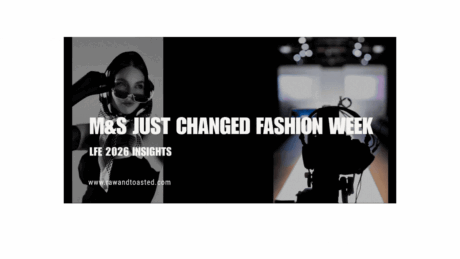
M&S showed at London Fashion Week for the first time. Ever. In its hundred-year history.
And it went full see-now-buy-now; shoppable online, in flagship stores across the UK, in selected international markets, the second the show ended. Which means somewhere in Britain, someone’s nan and someone’s TikTok-brained little cousin were shopping off the same runway drop, in real time, off a brand that has never once in its life been described as “cool.” That’s more than a trend, it’s really a coup.
Okay but why is this the story and not the bows
Because fashion week is, structurally, a hype machine for aesthetics. It exists to make you feel something about a silhouette. That’s the job, that’s the format, I love it, no shade. But it means the coverage will always chase what’s pretty over what’s actually rewriting the rules, supply chains don’t photograph well, babe, aprons do.
So while everyone was out here cataloguing checks vs. florals, M&S’s CEO Stuart Machin was calling this debut a reflection of the brand’s focus on style, quality, value and accessibility. Indeed, it is a corporate-speak, but I decoded it and here’s what it says, we just used the most exclusive, invite-only stage in British fashion to do the single most democratic thing a brand can do with it. And the British Fashion Council’s own CEO, Laura Weir, described the wider moment as proof that heritage, innovation and accessibility can meet to connect design with consumers in genuinely new ways. That quote wasn’t really about one collection. That’s the BFC smartly announcing what London Fashion Week is now; increasingly built around the consumer, not just the image of one.
(Translation – LFW isn’t just for the girls who understand couture. It’s turning into a checkout page with better lighting.)
“But see now buy now isn’t even new”, okay smarty pants
Correct, and I love that you know things. Burberry did this back in 2016. H&M ran its own version at Paris Fashion Week, live-streaming the show and dropping the collection the next day. So no, M&S didn’t invent the format. What changed is who’s doing it and why it finally works.
In 2016, see-now-buy-now was a luxury flex, a hype stunt bolted onto a house that didn’t structurally need the sales velocity. Ten years later, it’s a value retailer running it as core strategy, precisely when the UK high street needs every advantage it can scrape together. That’s the difference between “gimmick” and “the industry quietly recalibrating in front of you” and it’s exactly the distinction that gets lost the second a runway recap becomes a listicle titled “7 Trends To Steal.”
Here’s the real math underneath it: the traditional fashion calendar has a six-month gap between “shown on runway” and “available to buy.” That gap is where the industry’s forecasting risk, markdown chaos, and consumer boredom all quietly live. Meanwhile trend cycles now move at TikTok speed, weeks, not seasons, while production still runs on a rhythm designed in the 1990s. See-now-buy-now isn’t a vibe. It’s a direct hit on that lag. And M&S has the stock depth and supply chain maturity to actually pull it off without the classic “website crashed, everything sold out in four minutes, everyone’s furious” first-gen chaos.
What this means for the UK, no cap
M&S doesn’t do stunts for the plot, in fact its whole turnaround under Machin has been ruthlessly commercial, from Percy Pigs quietly colonising American shelves to a genuinely disciplined value repositioning. So a hundred-year-old institution choosing its centenary year to debut on the LFW runway, shoppable, is a flex with intent: the high street wants cultural relevance, not just a spot on the price-comparison chart. Expect Next, Uniqlo, and the supermarket clothing lines to start testing the same play over the next year or two. The old hierarchy, “designers show it, high street copies it two seasons later” is dissolving in real time, and whoever claims “accessible British style” first gets to own that lane.
Plot twist number 2; this is genuinely great news for physical retail. See-now-buy-now only works if the stock is already sitting in stores ready to move the second the show wraps. That’s a rare case where a legacy retailer’s unglamorous, much-memed store footprint becomes an actual competitive advantage over digital-native brands who’d have to build that fulfilment speed from absolute zero.
What this means for India, and why I’m genuinely excited
Okay this is the part where my 2 markets collide and I get a little feral. India has quietly been building the consumer behaviour for this exact model for years, just not through a traditional runway. Livestream and social commerce, where a look drops and you buy it in the same breath, is already completely normal across Indian D2C fashion, beauty and jewellery. Lakmé Fashion Week has been leaning consumer-facing and digital-first for seasons now.
So when Western high street formalises “show it, ship it,” it’s basically catching up to demand-side behaviour India already lives in. And on the supply side, India’s garment and textile manufacturing base is built exactly for this: speed, flexibility, scale. As Western retailers commit harder to compressed timelines, sourcing conversations tilt toward manufacturing partners who can move fast, not just cheap. That’s real opportunity for Indian export houses to reposition as speed-to-market partners rather than pure cost play and a wide-open lane for Indian D2C fashion labels to just… take this format and run, since the livestream-shopping habit is already baked in over there in a way Western markets are still trying to manufacture from scratch.
The global scope, zoomed all the way out
H&M tested it in Paris. Burberry tested it in London a decade ago. Now a genuinely mass-market, hundred-year-old institution is running it as a core identity move, with the BFC actively pushing the whole event in that direction. When a format graduates from “luxury PR experiment” to “value retailer’s operating model,” that’s usually the tell it’s about to stop being a novelty.
My prediction, and you can hold me to it – by 2028, see-now-buy-now stops being a headline and becomes the assumed default for anyone with real retail scale. Meanwhile the actual luxury houses will keep the traditional six-month lag on purpose because delay becomes the new exclusivity. Owning the wait becomes the flex. Access flips into the thing money can’t buy.
The bit everybody’s sleeping on
Every fashion week gives you 2 kinds of stories; the ones that look incredible on your feed, and the ones that actually move the market. This season, McQueen gave us the former, spectacularly, genuinely go watch it, worth every second. But M&S, of all brands, quietly handed us the latter. Nobody’s writing “5 Ways To Style The M&S Runway Look,” because a shoppable cardigan doesn’t have chainmail’s aspirational pull. But if you actually want to know where fashion retail is headed London, Mumbai, everywhere in between, you’ll learn more watching the brand nobody’s talking about than the one everyone is.
That’s the job. Sass, stats, and strategic takeaways, even when the strategic takeaway is wearing a meal-deal logo. 😉
Until next time,
Love, Jasmin