The Luxury Designer Is Now Working at Zara, And Honestly? We Should Have Seen This Coming.
Hola Sugarcups,
Something happened in fashion this week that I’ve been turning over in my head since Thursday, and I think it’s actually one of the most interesting structural stories in the entire industry right now.
GU, the brand that sells $18 jeans, Uniqlo’s younger, cheaper, more trend-obsessed sibling, just unveiled its first ever collection overseen by Francesco Risso, former creative director of Marni, and Prada-trained. One of the most genuinely respected creative minds to come out of Italian luxury fashion in the last decade. $18 jeans, Marni’s creative director, same collection.
At the same time, Zara, the brand your mum, your intern, and your most stylish friend all shop simultaneously, is five months away from dropping its first collection with John Galliano. Ex-creative director of Christian Dior, ex-creative director of Maison Margiela, and one of the greatest couturiers of the last 30 years, full stop. First collection lands September 2026. And Uniqlo, already the most silently dominant global clothing brand of the last 5 years, has Clare Waight Keller as its creative director. The same Clare Waight Keller who designed Meghan Markle’s wedding dress at Givenchy and ran Chloé before that. 3 of the most prestigious creative names in global fashion, 3 mass-market brands, and all happening simultaneously, landing in the same 6-month window.
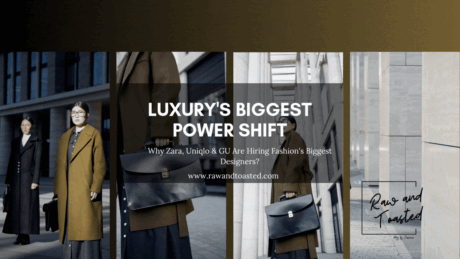
Yes, this is more like a structural shift, not just mere coincidence. And it tells you about where fashion is going for consumers, for brands, and for the entire creative ecosystem that sits between a £20 rail and a £2,000 showroom.
Let’s Start With the One That Happened Literally This Week
GU needs a moment of context, because outside Japan it’s relatively unknown, and that’s precisely the problem it’s trying to solve. It is Fast Retailing’s budget arm; the group that owns Uniqlo, which is currently the 3rd largest fashion retailer in the world and closing in on H&M’s number-two spot. GU’s pitch is, even cheaper than Uniqlo, but more trend-conscious, more fun, for Gen Z. $18 jeans versus Uniqlo’s $26. 2,000+ stores, almost entirely in Japan and a handful of Asian markets.
The problem, stated plainly by Fast Retailing’s own CFO last week; previous GU collections did not resonate well with younger consumers. Operating profit fell 9.5% last year. Its New York SoHo flagship, which opened in 2024 with considerable fanfare, has been its only Western outpost, and it’s not exactly setting Manhattan alight. Fast Retailing’s founder Tadashi Yanai has a long-term revenue target for GU of ¥1 trillion. Current annual revenue: ¥331 billion. Roughly one-ninth the size of Uniqlo.
So, hire Francesco Risso.
The collection unveiled in Tokyo on July 16 spans 6 design themes; minimalist, classic, playful, sports-inspired, bright colour tones, patterns. It will hit Japanese stores in late July. The global rollout comes after. Risso himself has talked about the appeal of scale, the idea that you can do genuinely interesting creative work and have it reach millions of people rather than the few thousand who can afford Marni RTW pricing.
Achim Berg, former McKinsey luxury and fashion division head, put it neatly, “There’s a greater fluidity between high-end fashion, luxury and the mass market.” This move is part of a larger pattern of mass-market brands recruiting luxury talent specifically because that talent is and I want to be honest about this, increasingly available.
Why the Luxury Designer Is Available
Here is the thing about the luxury creative director job in 2026 that the industry doesn’t love to discuss publicly. It is, by most accounts, a brutal role right now.
The churn at the top of luxury houses has been extraordinary. Galliano left Margiela in 2024, Risso left Marni in 2024, Jonathan Anderson is leaving Loewe, Sarah Burton left Alexander McQueen, Matthew Williams left Givenchy, Peter Hawkings lasted a single season at Tom Ford, Kim Jones stepped back from Fendi. The list goes on, and each departure is framed as a personal creative decision or a “natural evolution,” but the aggregate picture is of an industry consuming creative directors faster than it can develop them, inside structures that, particularly post-pandemic, and precisely with luxury’s Great Reset bearing down, are asking designers to simultaneously invent, communicate, film, franchise, license, and personally front a global media presence, while also managing an atelier, a supply chain, and a conglomerate board.
The luxury house of 2026 is not a creative paradise any more, but in fact, is a content machine with a heritage backstory and an increasingly impatient parent company. The creative director is not just the designer. She is the brand’s face, its cultural strategy, its social media asset, and its justification for a price point that has been rising 7-10% annually for 3 years running. The job has expanded in every direction simultaneously while the creative freedom at the centre of it has, in many cases, contracted.
And so when Zara comes to John Galliano and says, here is a 2-year contract, the access to our entire archive, here is a brief that is essentially “do whatever you find interesting with this material”, and here is the platform of one of the largest retail brands on earth, the question stops being “why would he do this” and starts being “why on earth wouldn’t he.”
“To deliver fashion through that enormous platform, that’s thrilling,” Galliano told Vogue. “And to be able to work with the kind of resources they have, that’s equally thrilling.”
That is a man who has found something that, creatively, is more interesting than what was on offer elsewhere.
What Zara Is Actually Getting From This (Hint: It’s Not Just Good Press)
Let’s be analytical about the Zara-Galliano deal for a sec, because it’s worth understanding what Inditex is actually buying here. And it is not, primarily, buying collections. It’s buying something considerably more structural.
Zara posted record annual profits for the 3rd consecutive year in 2025. It has Bad Bunny wearing its clothes at the Super Bowl in February. It has a Galliano collaboration dropping in September. It has previously worked with Narciso Rodriguez, Stefano Pilati, Kate Moss, and Steven Meisel. These are not random choices. They are a very deliberate, systematically executed reputational strategy to reposition Zara from “the place you go when you can’t afford the real thing” to “the place you go because the creative conversation is happening here now.”
The eMarketer analysis of the Galliano announcement cuts to it cleanly, the partnership is designed to elevate brand perception and price points to offset growing competition from Shein and Temu and the structural cost pressures of tariffs. The scarcity of the Galliano collections, limited drops, archive-informed, one-of-a-kind in concept, can justify a premium within Zara’s range that the regular collection simply can’t command.
There’s a second, less obvious thing Zara is buying; the resale market. Galliano’s secondhand prices are extraordinary. His Dior archive pieces command thousands at auction. His Margiela Artisanal work is reselling at multiples of retail within months of a show. By attaching his name and creative process to Zara pieces, even pieces that retail at £60 or £90, Zara is creating, deliberately, the conditions for a resale premium. A Galliano-for-Zara piece in 3 years is not just a well-made garment, but is a collectible with a credible creative lineage. And a brand whose pieces have resale value is a brand that gets positioned, by the consumer, alongside things that have resale value. Which is to say, alongside luxury.
That is an extremely sophisticated repositioning strategy dressed up as a creative collaboration announcement. And it cost them a fraction of what acquiring a luxury brand or building a house from scratch would.
The Uniqlo Angle: How to Do This Smartly Nobody Noticed Until Now
What makes this story bigger than just Zara and GU is that Uniqlo has been running the same playbook for years already, and running it more quietly and more effectively than anyone else in the market.
Clare Waight Keller, their current creative director, is not a secret. She is not a low-profile industry figure. She designed one of the most photographed dresses in the world; Meghan Markle’s wedding gown at Givenchy in 2018. She ran Chloé for 7 years before that, she is, by any measure, one of the most accomplished British designers of her generation. And she is currently making jumpers and trousers and shirts for Uniqlo’s LifeWear collection at price points that start at £15.
Uniqlo’s R&D global head Yukihiro Katsuta has been explicit about the strategy, push LifeWear on multiple fronts, diversify into accessories, and scale GU as the ultra-affordable trend-conscious complement. But what he doesn’t need to say is what Clare Waight Keller’s presence communicates on its own, that the design intelligence sitting behind a £29 Uniqlo linen shirt is the same design intelligence that once sat behind a £2,900 Givenchy coat. The price is different, the creative lineage is the same.
This is the part of the luxury-to-mass designer migration that is most interesting to me analytically, because it quietly demolishes one of the most persistent myths in fashion. Which is that expensive clothes are expensive because of the design talent, and cheap clothes are cheap because of the design talent. Historically, that was partially true. In 2026, it is not. The design talent is, increasingly, wherever the interesting creative brief is and the interesting creative brief is, increasingly, in the hands of the brands that have scale, resource, and the commercial confidence to give a creative director genuine latitude rather than a quarterly performance review.
What This Means For You (Whether You Shop at Zara or Not)
I want to give you the honest version of what this shift means in practice, because it’s easy to get distracted by the celebrity of the names and miss what’s actually changing.
If you’re a Zara shopper: September is going to be interesting. The Galliano collection will be limited, archive-informed, and almost certainly sell out quickly. Think of it less like a normal Zara drop and more like a collaboration piece; buy what you love immediately, because resale is going to be a real secondary market for these. The pieces will have a creative lineage worth owning.
If you’re a founder or brand strategist: The strategic lesson here is about creative credibility as a commercial weapon. Zara is not hiring Galliano because it needs help designing clothes. It’s hiring him because it understands that in a market flooded with cheap alternatives, the thing that separates brands is not just price or quality, it’s perceived creative authority. You don’t need Galliano. But you do need to think about who or what gives your brand the same signal function. Who makes your customer feel like they’re participating in something with creative intelligence, not just consuming a product?
If you work in fashion, at any level: The creative director job description has fundamentally changed. The most interesting creative briefs in the industry right now are not at the houses, but they are at the brands with scale, resource, and the confidence to let designers actually work. If you’re early in your career and dreaming of the luxury atelier, that dream is worth interrogating. The most exciting creative work happening globally in fashion right now is, increasingly, the work that lands at GU, at Zara, and at Uniqlo. Not because those brands have sold out luxury. Because luxury has quietly sold out the creative brief.
And if you’re just following along because this stuff is genuinely fascinating: Yes, it is the best designers in the world are making your Zara basics. And the best part is that, the basics are going to be extraordinary.
My Analytical Note: This piece is anchored to 3 concurrent, live stories all breaking in the same 6-week window. The GU/Francesco Risso announcement, GU’s FW2026 collection unveiled July 16, 2026, reported by Bloomberg, Japan Times, FashionNetwork USA, and Nikkei Asia, is the freshest story, 3 days old at time of writing. GU’s operating challenges (9.5% operating profit decline, CFO Takeshi Okazaki’s acknowledgement that previous collections failed to resonate with younger consumers, ¥331 billion current revenue vs ¥1 trillion target) are sourced from Fast Retailing financial disclosures and FashionNetwork reporting.
The Zara/Galliano 2-year creative partnership was announced March 17-18, 2026, reported by Forbes, Marie Claire, W Magazine, Harper’s Bazaar, and eMarketer, first collection confirmed for September 2026. Galliano’s creative brief (reworking Zara’s archive through a “haute couture process,” communicating directly with CEO Marta Ortega Pérez) and his Vogue quote are from the official partnership announcement and Vogue’s interview coverage. The Uniqlo/Clare Waight Keller creative direction and Fast Retailing’s GU expansion strategy are sourced from the FT/Irish Times profile of Uniqlo (July 1, 2026) and Modaes Global’s 2026 fashion retail rankings.
The eMarketer analysis of Zara’s strategic positioning (brand elevation to offset Shein/Temu competition and tariff pressure) and the Achim Berg McKinsey quote on luxury-to-mass creative fluidity are directly sourced from eMarketer and Briefs.co’s July 17, 2026 coverage. Note: the piece’s argument about luxury creative directors’ challenging working conditions is the author’s analytical synthesis, drawing on the pattern of departures rather than any single reported source, and is presented explicitly as analytical interpretation.
Until next time,
Jasmin xx