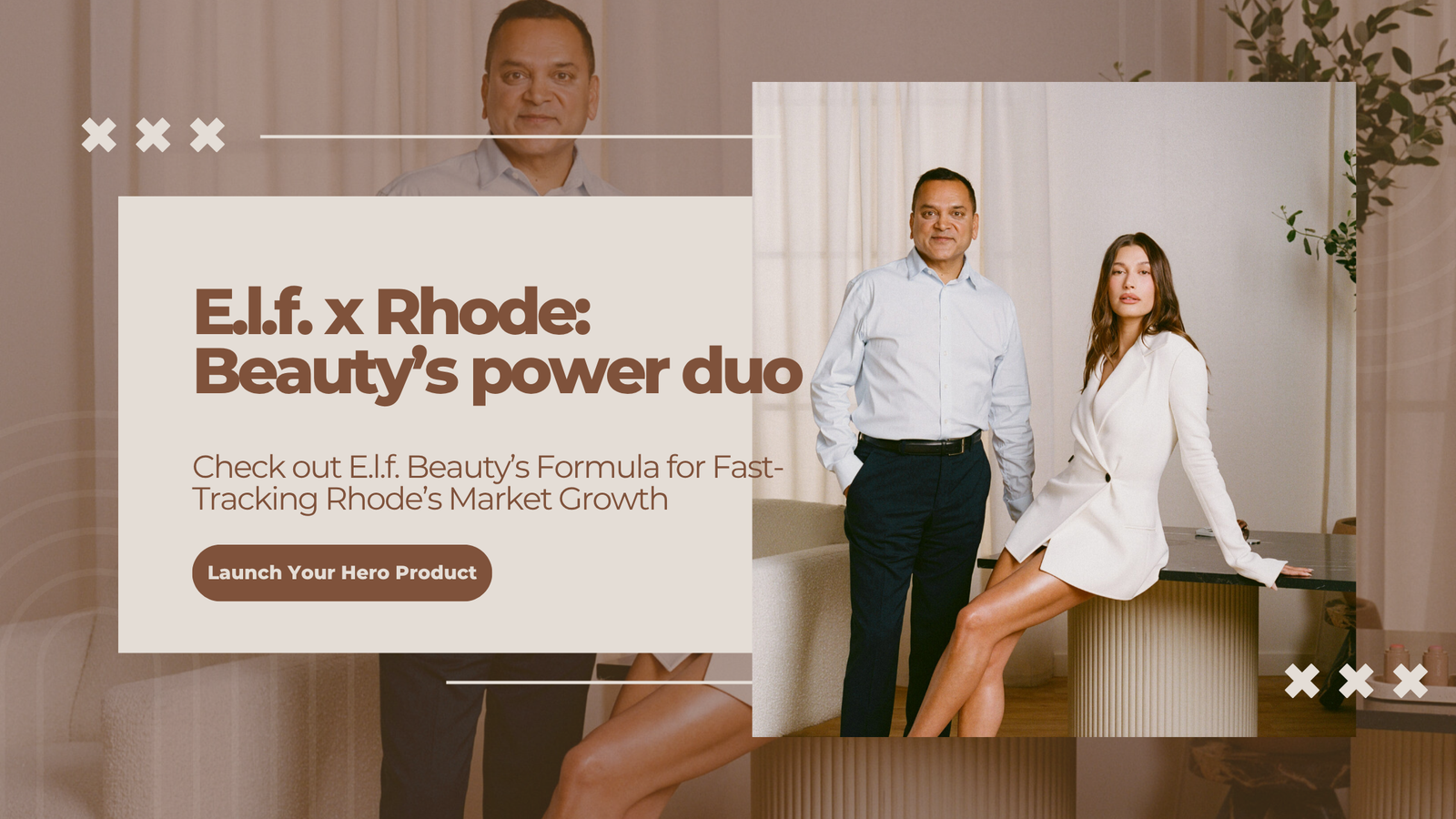
Hola Sugarcups, Rhode has just changed the definition of a beauty exit- and E.l.f. understands it.
Alright. For the record? When Hailey Bieber introduced Rhode in 2022, I was skeptical. I recall scrolling past it, saying, “Ugh. Another celebrity skincare line? Because the world is just clamoring for more hyaluronic acid in a beige bottle, of course.” I am in the business of brand strategy. I’ve seen it all before: glamorous founder, abundant hype, forgettable product – and a PR team doing the cheerleading. So sure, I thought for sure Rhode was going to be another blip in the radar.
But then… The weirdest thing happened.
It didn’t flop.
It flew!
And not in that slow, cult-y, “oh the internet girlies know” way. I mean, sold-out launches, Tik Tok hype, rave reviews from actual skincare cultists, not Bieber stans. Rhode’s billion-dollar exit shows that creating a beauty brand isn’t just about the products-it’s about creating a tribe that loves you for the long haul. And just when I was about to be all ‘oh okay, I see the Peptide Lip Treatment is the new bimbie” when E.l.f. Beauty bought Rhode for an alleged billion dollar, in less than 3 years. Billion dollars. Not hype. Harvard Business School curriculum.
How E.l.f. Beauty Is Supercharging Rhode’s Growth at Lightning Speed

E.l.f. Beauty isn’t bringing another big name to the mass market to slap a label on makeup. They are betting on disruptors to grow together. The company’s Naturium deal in 2023 demonstrated they can take prestige-formulated products to a mass-market audience.
With Rhode, E.l.f. is banking on:
Premium pricing power: Rhode’s product price points at retail are in the $18-$38 range which is an insignificant driver for E.l.f.’s profit margins.
Sephora expansion: E.l.f. brands tend to do well in Target and Ulta, but Rhode, a new E.l.f. brand, is giving the company its first foothold in Sephora US, Canada and UK.
E.l.f. acquisition helped E.l.f. acquires: Rhode’s involvement-focussed approach is perfectly suited to the digital-first online marketing that was always E.l.f.’s primary approach, like Super Bowl ads and influencer deals.
So… What Did Rhode Do That Everyone Else Missed?
Here’s the thing: Rhode didn’t open with a tidal wave of 40 products, celebrity endorsement and rainbow packaging. It opened quietly confident, almost sparse, as if it had nothing to prove. And that might be what made it work. Where other brands are trying to be all things to all people, Rhode was laser-focused on one thing doing one thing, really, really well. Rhode focused on supporting skin barrier health with the offering of hydrating, plumping, dew-like skin. That promise was built into the very fabric of the brand – from product formulations to branding imagery to Hailey’s now-iconic ‘glazed donut’ aesthetic. And when people tried the product? They just kept coming back. Because it actually worked.
The Lip Balm That Started It All
Now, the Peptide Lip Treatment. This was Rhode’s Trojan horse. Not just a balm, it was a vibe. The feeling of being the girl who sips 64 oz of water a day, meditates, and has a five-step skincare routine and isn’t bothered by it. And Rhode’s lip balm was your “I have my shit together” balm. Everything was purposeful. 10 SKUs. No filler. Everything to feel natural and add up to an entire experience (think: everything you need for one complete routine). Rhode didn’t just launch a brand. She brought a mood.
Why I’m Now Using Rhode as a Client Case Study
If you’re auditing or snoozing over “Should we roll out a new product?” and “How many more SKUs do we need to beat the competition?” And now? I tell you to stare at Rhode. Because Rhode does it – elegantly, magnificently, and with lip gloss to boot – what you actually need:
The hero product that actually works to solve the problem,
A brand story so compelling that people want to be part of it,
And the courage to say no to distractions.
Let me break down Rhode’s glow-up in boardroom terms:
Hyper-Curated Lineup: 10 products. All killer, no filler. Think of Apple, but for the skin.
Borne of “Organically Viral” Bieber + Tiktok + “cracked donut skin” = commercial demand machine
The Brand: Founded online but quickly worked their way into the Sephora stores in the US, Canada, and UK = valid retail Credibility.
Cultural Synchronicity: Rhode didn’t follow the trends, it created them. It was everything Gen Z saw, bought, wore, and hashtagged.
Anyway, onto the real story: bought by E.l.f. Beauty for a billion dollars (alleged) E.l.f., which has been slowly ascending into the Amazon of young adult beauty. No, not a puff piece. A power move.
5 Steps To Building The Next Rhode – How To Build A Hero Product That Can Scale
Want to duplicate Rhode’s victory? Here’s the cheat for a beauty brand sitting pretty in skincare and eager to scale. But first, before I tell them to go and create another serum (yes, seriously), I begin with a thorough Market Pulse assessment.
Culture + Behavioral Trend Indicators
I’m seeing:
All the glam and none of the breakouts. Imagine a foundation with niacinamide, blush infused with hyaluronic acid, and so on.
Understated opulence – Customers are embracing minimum packaging, high-efficacy, “clean girl” aesthetics (credit Tik Tok and Sofia Richie’s wedding).
Ingredient mindful purchasing – Consumers pay more attention to what’s in a product than what the product claims to do for them.
Functional formats – Sticks, balms, hybrids are taking centre stage. No one is in the mood for fuss.
A single hero product that works = a sustainable long-term customer acquisition engine.
Color product with hybrid finish (think skin tint or balm) with skin barrier benefits AND glow finish. Clean, science-backed, under $35. None of the prestige-lite folks do this right now. Neither does Rhode.
1. Discern the White Space
Behind the success of every beauty brand victory lies a space in the market. Rhode leveraged science-driven skincare at a more affordable price point, and Patrick Ta Beauty and NARS are just two of the latest brands to introduce products focused on glow-boosting formulas.
Consider: What’s the gap? What problem will this product solve in a way that nothing else can?
2. Nail One Thing First
– Rhode didn’t flood the market with SKUs, but introduced only 10 products, starting with the Peptide Lip Treatment. Likewise Kérastase’s Gloss Absolu Glaze Drops is a stand-alone product designed to be the sole product you need to get glass hair.
Strategy tip: Consider emphasizing one product that can do a good job of “taking care” of the wardrobe before adding more to it.
3. Turn it Cultural, Not Simply Commercial
“Glazed donut skin” was not a marketing slogan; it was a way of life. Hailey adopted it. Tik Tok embraced it. Rhode retailered it. That’s how you get full-funnel cultural relevance, sweetheart.
Launch a Trend: Make your trend, not find one to follow.
4. Validate with Retail
Rhode’s US, Canada, and UK expansion into Sephora was a revolution. Mass retail growth signals a brand’s quality and facilitates a person’s widespread brand debut. Fresh Beauty’s most recent pop-up campaign reinforces its position as a best-in-class brand that embraces experiential retail.
Retail positioning: Begin with direct-to-consumer and then expand carefully into prestige.
5. Scale via Strategic Acquisition
E.l.f. Beauty’s purchase of Rhode wasn’t only about Hailey Bieber-it was about scaling a hero product, with operational might. In the same vein, Victoria Beckham Beauty recently introduced high-end makeup brushes-and used her name recognition to develop a new hero product.
Growth hack: Collaborate with a bigger beauty monopoly or investor to expand worldwide.
Rhode didn’t launch with a library. Rhode launched with a laser.
Until next time,
Love
Jasmin