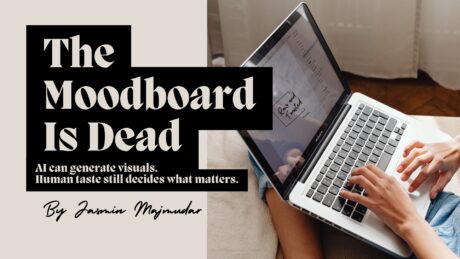
AI Killed the Mood Board, Now What Do Designers Actually Do All Day?
Hola Sugarcups,
“The mood board is dead. Long live the thing that replaces it, whatever that turns out to be.”
Stumbled into a stranger who said something to me at a tech event last month that I haven’t been able to stop thinking about. She’s a senior designer at a mid-size London fashion brand, one of those people who has been in fashion long enough to have lived through several waves of “this technology is going to change everything” and survived them all with her perspective intact. She said, “the weird thing about AI is that it’s the first tool I’ve used that makes me feel like I need to justify existing, not as a designer, but as a decision-maker.” That sentence has been rattling around in my head ever since. Because it gets at something that the standard AI-in-fashion conversation almost never addresses. We talk about what AI can generate, the speed, the scale, and the cost efficiencies, but we don’t talk nearly enough about what the introduction of AI into the creative process does to the human creative process. What it actually removes, what it reveals, and what it ultimately forces designers to become better at. So. What do designers actually do all day now that AI can build a mood board in eleven seconds?
The answer is considerably more interesting than “not much.”
First, What AI Has Actually Replaced (Let’s Be Honest)
I want to be clear-eyed about this because I think the fashion industry sometimes gets a bit defensive when this question comes up, and defensiveness doesn’t help anyone. Generative AI has genuinely replaced significant portions of early-stage design work. The mood board, that curated collection of images, textures, colour stories, and reference points that used to be the first hours or days of any collection, is now generated, iterated, and refined in minutes. A designer can type “1970s Moroccan textile patterns in a Transformative Teal palette with Art Deco structural references” and receive, immediately, hundreds of visual directions to work from.
Print design is similar. What used to require specialist print designers producing hand-drawn or digitally constructed textile patterns now has a gen-AI layer that can produce technically production-ready patterns to brief at a speed that would have seemed absurd three years ago.
Early colourway exploration, initial silhouette sketching, campaign imagery moodboarding, fabric-on-model visualisation, all of these have AI tools now that do them faster than any human and without a coffee break.
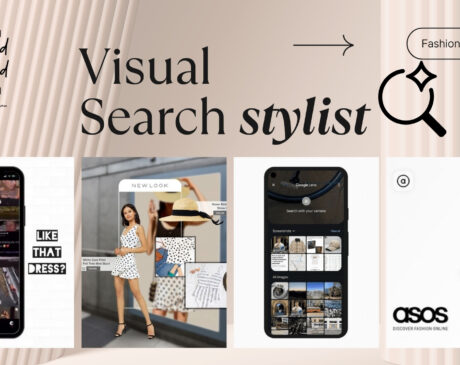
ASOS embedding AI across its design operation this year and upskilling 100+ designers in the process is the most visible manifestation of what’s becoming industry standard. The question is what it reveals about what design actually is, beneath these now-automated tasks.
What AI Cannot Do
Here’s what I’ve observed across conversations with designers at various levels of the industry, from luxury to high street, from London to global brands:
AI cannot make the decision about which direction is right. This sounds obvious but it’s profound. Generating a thousand directions is not the same as knowing which one to pursue. The judgment call, “this one, not that one, and here’s why it’s true to what we’re building”, is not something AI can make. It can surface options. But it cannot feel the rightness of one option over another. That judgment is taste, and taste is built from years of exposure, failure, market understanding, brand intimacy, and something close to instinct. No model has that.
AI cannot understand the cultural timing of an idea. A design direction might be technically excellent, beautifully executed, internally coherent, visually compelling, and also exactly wrong for this particular moment in exactly this particular market. Knowing the difference requires being a human who exists in the world, reading what’s in the air, understanding what consumers are moving toward and what they’re moving away from. The Fashion Core Trends piece I wrote earlier this year gets into how that cultural timing works, it’s not something that can be reduced to image analysis.
AI cannot hold the relationship with the maker. Fashion is not just ideation and production. It’s a relationship between design intent and the hands that realise it. Knowing what your manufacturer can actually do, what a particular atelier’s embroidery is capable of, how a specific weave behaves when it hits a curved seam, is embodied knowledge built over real relationships over time. AI can suggest, however, it will not negotiate that relationship.
AI cannot carry the brand’s truth. The best brands have a specific, irreducible identity, a point of view so clear that you’d know their work anywhere. Pharrell’s DROPHAUS moment for Louis Vuitton, which I wrote about here, is an example of brand truth that goes far beyond what any prompt could specify. That kind of vision is held by people, not models.
So What Are Designers Actually Doing Now?
The designers I’ve spoken to who are doing this well describe a shift that’s less about doing different tasks and more about operating at a different altitude.
Less time in generating options, building mood boards, exploring initial colourways, producing draft print designs.
More time in deciding between options (which requires taste and brand knowledge), understanding why an AI-generated direction is close but not right and articulating what “right” would actually look like. Additionally, developing the cultural and market intelligence that makes those decisions better, working more closely with the maker relationships that tech and intelligence cannot replicate, and this is the one that surprised me most, developing better written briefs.
Because this intelligence is only as good as what you ask it. The designer who can write a precise, culturally intelligent, brand-specific brief for a generative AI tool is getting dramatically better output than the one who’s using it like a Google image search. That skill, the ability to translate creative vision into language that the machine can work with, is genuinely new and genuinely valuable. It’s essentially a new form of design literacy.
The Existential Bit (Bear With Me…)
Because what the tech has done, by removing the lower-altitude tasks from the design process, is make the higher-altitude tasks impossible to hide from. When you spend your day generating mood boards, you can feel like a designer even if your decision-making is fuzzy. When AI generates the mood boards and you’re left with only the decisions, the quality of your judgment becomes very visible very quickly.
This is uncomfortable. It’s also, I would argue, exactly what the industry needed. Fashion has always had too many people in decision-making roles who were better at looking like they had taste than actually exercising it. AI is a fairly brutal revealer of the difference.
This is not comforting to say but nonetheless, the designers who are thriving right now are the ones who always had genuinely good judgment and are now freed from the tasks that were consuming their time. The ones struggling are the ones who were better at the tasks than the judgment.
What AI in Design Means for the Future
If design is increasingly about decision-making, taste, cultural intelligence, brand truth, and maker relationships, then the pipeline for developing designers needs to change. You can’t teach taste in an intelligent-tools workshop. You teach it through deep exposure to fashion history, cultural context, materials, how things are made, and how consumers actually live in their clothes. The tactile, time-consuming, body-based education that design schools have sometimes treated as foundational is now more essential, not less.
The paradox is that as AI handles the visual generation layer, the human layer needs to become more embodied, more material, more rooted in physical reality. More of the things I wrote about in The Tactile Rebellion. Less screen-mediated, not more.
The most future-proof fashion designer in 2026 is not the one who’s best at prompting AI tools. It’s the one who brings enough cultural intelligence, sensory knowledge, and genuine taste to the process that the AI’s output becomes something it couldn’t be without them.
That person will always have a job. And honestly? They deserve it.
Jasmin x
P.S. This connects directly to what’s happening at the consumer end of fashion, where the same shift is playing out. AI is creating infinite visual fashion content, and the people who’ve developed genuine taste are becoming the ones who can navigate it. More on that over on my AI & Sustainability section.